

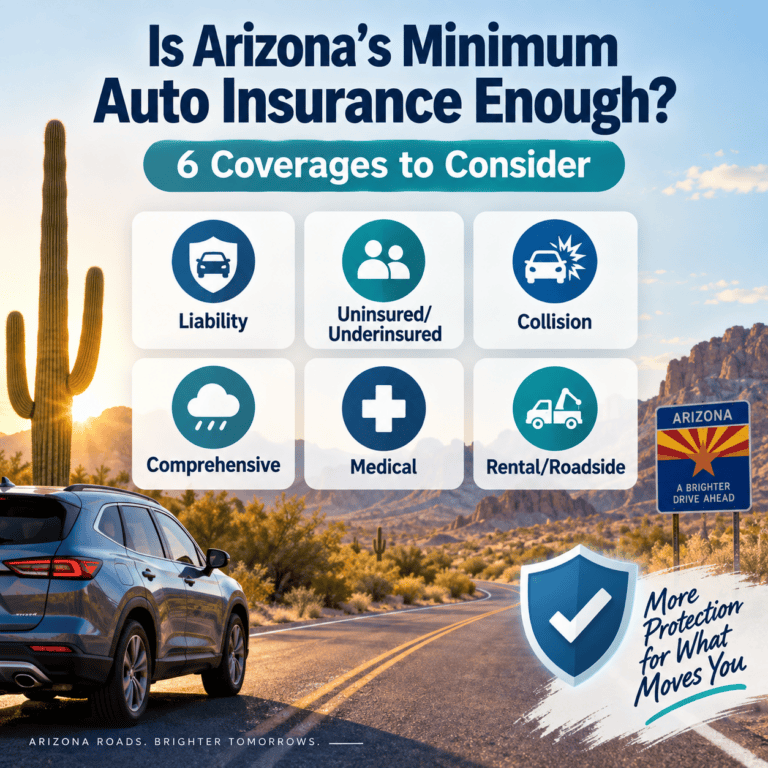
Is Arizona’s Minimum Auto Insurance Enough? 6 Coverages to Consider
Arizona’s minimum auto insurance meets the state’s basic legal requirement, but it may not provide enough protection after a serious accident. Arizona MVD requires drivers to carry liability insurance, but meeting the legal minimum does not necessarily mean you have enough protection for a serious accident.
Arizona’s minimum liability limits are 25/50/15: $25,000 for bodily injury to one person, $50,000 for bodily injury to two or more people, and $15,000 for property damage.
Those limits may satisfy state law, but medical bills, vehicle repairs, and other accident-related costs can quickly exceed them. When choosing auto insurance, it is worth considering how much financial protection you would want if something unexpected happened.
1. Higher Liability Limits
Liability coverage helps pay for injuries or property damage you are legally responsible for causing.
Arizona’s $15,000 minimum property-damage limit could be exhausted quickly if you seriously damage a newer vehicle, multiple vehicles, or other property. Likewise, medical expenses following a major accident can exceed minimum bodily-injury limits.
Arizona’s Department of Insurance notes that drivers may purchase liability limits above the state minimum and should consider both affordability and the assets they could potentially put at risk after a serious accident.
2. Arizona’s Minimum Auto Insurance: Uninsured and Underinsured Motorist Coverage
Uninsured Motorist, or UM, coverage can help protect you and your passengers if you are injured by a driver who does not have liability insurance. Although Arizona requires drivers to carry insurance, not every motorist on the road is insured. Arizona DIFI specifically identifies UM coverage as protection for bodily injuries caused by an uninsured driver.
Underinsured Motorist, or UIM, coverage can help when the at-fault driver has insurance, but their liability limits are not high enough to cover all of the injuries caused in the accident.
Arizona insurers must offer UM and UIM coverage, although consumers may choose whether to purchase them. These coverages can provide an additional layer of protection beyond Arizona’s minimum auto insurance, especially when another driver has little or no insurance.
3. Collision Coverage
Liability insurance generally pays for damage you cause to someone else’s property. It does not automatically pay to repair your own vehicle.
Collision coverage can help repair or replace your vehicle following a covered collision, subject to your deductible.
This may be particularly important if replacing or repairing your vehicle out of pocket would create a financial burden.
4. Comprehensive Coverage
Not every loss involves another vehicle.
Comprehensive coverage generally protects against certain non-collision losses such as theft, vandalism, weather-related damage, falling objects, and some types of glass damage, depending on the policy.
If you have a newer or higher-value vehicle, comprehensive coverage may be worth considering alongside collision.
5. Medical Payments Coverage
Medical payments coverage, sometimes called MedPay, can help with necessary medical and funeral expenses for you or passengers in your vehicle following an automobile accident, up to the policy limit.
Arizona DIFI notes that MedPay may also help with deductibles or copayments that are not covered by a person’s health insurance.
6. Rental Reimbursement and Roadside Assistance
These optional coverages may not protect against the largest financial risks, but they can make an accident or breakdown much easier to manage.
Rental reimbursement can help pay toward a temporary rental vehicle following a covered loss, while roadside assistance may provide services such as towing, jump-starts, or help with a flat tire, depending on the policy.
So, Is Arizona’s Minimum Auto Insurance Enough?
Arizona’s minimum auto insurance can be a starting point, but higher liability limits and additional coverages may provide better financial protection depending on your needs. Arizona’s minimum liability insurance allows you to meet the state’s basic insurance requirement, but the minimum may not provide the level of financial protection you want after a serious accident.
The right amount of auto insurance depends on factors such as the value of your vehicle, your assets, your budget, the amount of risk you are comfortable assuming, and whether your vehicle is financed or leased.
Rather than choosing coverage based only on the lowest premium, compare liability limits, deductibles, uninsured and underinsured motorist protection, collision, comprehensive coverage, and optional benefits.
A few extra dollars in premium can sometimes represent substantially more protection when you actually need to use your insurance.
Contact Eleanor
📞 858-247-1189
✉️ insureme@eleanorlsoto.com
🌐 YesInsureMe.com
